Balter
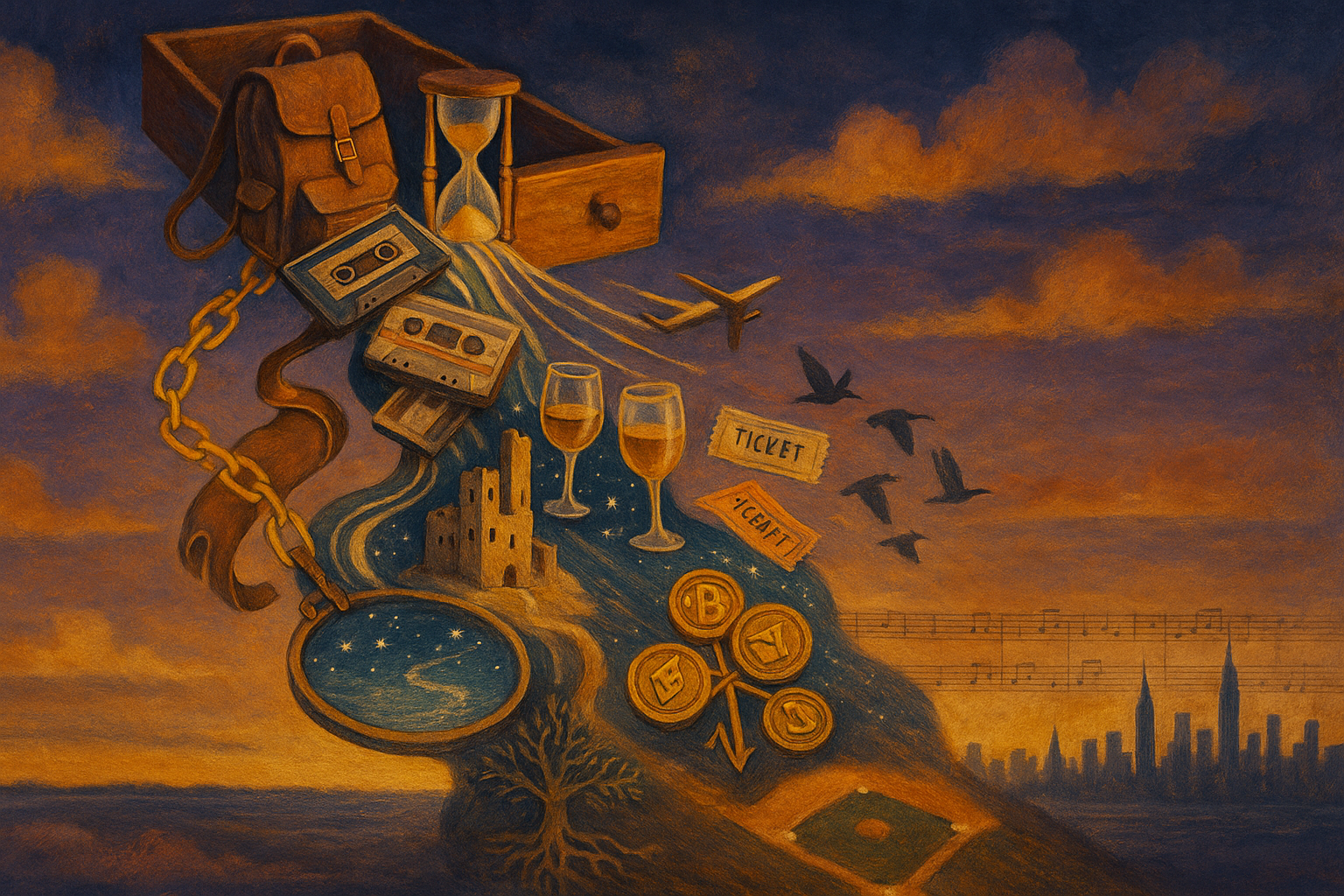
Balter's body of work is governed by a central tension he never quite resolves, and which supplies most of the energy on the page: the compulsive builder who cannot stop moving forward set against the grieving son, the divorced father, the man who hasn't cried in fourteen years and writes about it with something approaching bewilderment. The early Inc. columns are competent startup-leadership fare — mentor well, stay humble, befriend your rivals — but even there the confessional impulse bleeds through, as when he admits his ego nearly destroyed BzzAgent before its sale. What happens over the subsequent decade is a slow, jagged migration from prescriptive business writing toward personal essay, culminating in the Balterer newsletter pieces of 2025 and 2026, where the voice finally coheres into something distinctly his: digressive, self-interrupting, profane, tonally restless, toggling between standup-comic timing and genuine anguish. The serialized "Storyer of Smarterer" is the fullest expression of this mode — startup memoir rendered as picaresque, where accidentally smoking PCP and negotiating an acquisition coexist in the same register, because for Balter the chaos is the register. His father's decline and death across "Let Go, Dad," "Hospice," and "So Long, Dad" constitute the emotional spine of the entire catalog, the place where the wisecracking deflections finally buckle under weight they cannot carry off.
What recurs across the work is not a subject but a posture: the narrator who tells you the rules of engagement before breaking every one, who insists on irreverence as a structural principle while circling themes — mortality, loyalty, the transactional nature of trust, the strangeness of money — that demand earnestness. The Grateful Dead and Eggy pieces, the weed writing, the Twelve Tribes cult digression, the tape-dub entrepreneurship origin story — these are not lifestyle content but attempts to locate a self that was formed in subcultural devotion and serial company-building and can't fully account for either. The self-authored fake book review of "Invisible" is the most revealing gesture in the catalog: a writer constructing his own critic, preemptively ventriloquizing the charge that recognition has been mistaken for revelation. Balter writes like a man running a machine he has named but cannot turn off, and the best pieces succeed precisely where control lapses — where the grief for his father outpaces the joke, where the marriage to his co-worker complicates the founder narrative, where the airplane bathroom rant curdles into something genuinely misanthropic. The contradictions are the work: sentimentality armored in swagger, vulnerability delivered as bit, a founder's confidence undercut by a recurring suspicion that building things may be compulsion rather than calling.
Balterer's catalog reads like a man arguing with himself in public and daring you to look away. Across forty-one pieces, the dominant register is confessional bravado — a voice that insists on its own candor while stage-managing every revelation. The writer circles obsessively around a handful of gravitational centers: fatherhood and filial duty, the mythology of entrepreneurship, the Grateful Dead and its cultural penumbra, and the body's stubborn refusal to cooperate with the mind's preferred self-image. What links these seemingly disparate concerns is a fixation on control and its failures — the father who cannot cry for fourteen years and then writes about it with forensic precision, the founder who narrates acquisition deals as if they were heist films, the concertgoer who inventories the sensory data of a stranger collapsing on the floor. The parenthetical asides, the direct addresses to the reader, the constant throat-clearing disclaimers ("house rules," "rule of play," "for avoidance of doubt") — these are not stylistic tics so much as load-bearing architecture. They allow Balterer to approach vulnerability at an angle, to arrive at genuine feeling by pretending to dodge it.
The intellectual timeline reveals a writer who began with entrepreneurial narrative and gradually loosened toward something rawer and more personal, though the two modes never fully separate. The seven-part Smarterer series is the catalog's spine: a serialized founder's memoir that doubles as a study in how deals, relationships, and self-delusion intertwine. But the pieces that genuinely distinguish the work are the ones where commerce falls away and mortality moves in — the father's Parkinson's decline across "Let Go, Dad," "Hospice," and "So Long, Dad" constitutes an involuntary triptych, each installment less defended than the last, the jokes growing thinner as the oxygen does. The father who shouts "I am a carrot! I am a cucumber!" from the edge of death, and the son who recognizes this as a man trying to articulate that he feels like a vegetable — that is writing operating at a level the startup narratives, however entertaining, do not reach. It is also where Balterer's signature move, the deflection into humor, becomes most legible as a survival mechanism rather than a rhetorical strategy.
What keeps the catalog from cohering into something greater is a certain reluctance to let the reader sit in discomfort without a wink. The voice is unmistakable — rapid, digressive, allergic to solemnity, fond of em dashes and sentence fragments that mimic the cadence of a man thinking aloud at a bar. But the relentless knowingness can sand down the edges of pieces that deserve their sharpness. "When You Cry" opens with a confession of startling emotional honesty and almost immediately retreats into ironic distance. The fabricated book review of the writer's own essay, "Invisible," is the most structurally adventurous piece in the catalog, a hall-of-mirrors exercise in self-criticism that reveals how acutely Balterer understands his own tendencies — and how unwilling he remains to fully abandon them. The range is real: from weed memoirs to blockchain analytics, from Miranda July to airplane etiquette to hallucinogenic cult encounters. But the deepest current running beneath all of it is the tension between a man who builds compulsively — businesses, essays, weekly publishing schedules, what he calls "The Machine" — and one who suspects that all this building is an elaborate scaffolding around something he cannot bring himself to simply stand inside and feel.
Balterer's body of work reads like the memoir of a man who cannot stop building things — companies, essays, justifications — and who has come to understand, perhaps only recently, that the compulsion itself is the subject worth examining. Across forty-one pieces, published in a concentrated burst between late 2025 and early 2026, the writer returns obsessively to the tension between control and surrender: the father who won't use a cane, the entrepreneur who micromanages font choices, the insomniac parsing mortality into phases, the man who hasn't cried in fourteen years and describes willing himself toward tears with the mechanical focus of someone debugging code. There is a restless, almost feral energy to the prose — parenthetical asides that undercut the writer's own authority, self-deprecating pivots that function as preemptive strikes against sentimentality, sentences that lunge forward then pull back into wisecracks. The voice is unmistakable: a raconteur who deploys irreverence as structural load-bearing, who uses humor not to avoid depth but to negotiate safe passage toward it. The piece on crying and the pieces on his father's death trace a single arc — the writer circling the problem of male emotional constipation with increasing directness, moving from abstraction in "When You Cry" to the devastating specificity of a dying man shouting "I am a carrot" in "So Long, Dad." That the father predicted his own death on Rosh Hashanah lands with genuine force precisely because Balterer has spent so many words elsewhere resisting exactly this kind of unearned gravity.
The Smarterer series, spanning seven installments, represents both the most sustained narrative effort in the catalog and its most revealing structural choice. Balterer is drawn to the startup founding myth but refuses to play it straight — the co-founder who decamps for Burning Man, the intern who works for free in probable violation of Massachusetts labor law, the acquisition negotiated alongside a romantic entanglement with an employee. The business writing and the personal writing are not, it turns out, separate registers; they are the same register applied to different materials. Whether the subject is a blockchain analytics company, a driver named Maruf who embezzled twenty thousand dollars, or the physiology of a concertgoer collapsing at a Phish show, the method is identical: arrive at the scene with comic bravado, circle the perimeter with anecdote and digression, then drop — sometimes gracefully, sometimes with a thud — into something raw. The Grateful Dead and Phish function as more than biographical color; they are the writer's native liturgy, the framework through which chaos and improvisation are made legible. Tape trading, cult encounters on LSD, the Dead's post-Mydland darkness — these are not nostalgia pieces but attempts to locate the origins of a particular disposition toward risk, community, and the unreliable nature of plans.
What makes this catalog genuinely interesting, rather than merely energetic, is the late emergence of self-scrutiny. The invented book review of "Invisible" — a piece in which Balterer fabricates a critic named V. A. Delbert to pan his own work — is the most formally adventurous thing here, and also the most telling. It suggests a writer who has begun to suspect that his greatest subject might be the gap between performance and interiority, between the guy who commandeers the airplane bathroom and the one who sits by the pool unable to cry while his partner weeps. The Miranda July piece performs a similar function under the guise of a book review: all those preemptive disclaimers about manhood and spoilers are the scaffolding around a writer trying to engage with feminine interiority without the tools to do so comfortably. There are weaknesses — the comic tics can become tics in the clinical sense, repetitive and involuntary; the parenthetical self-interruptions occasionally drain momentum from passages that would land harder if left alone; and the writer's instinct to charm can crowd out the stillness these pieces sometimes desperately need. But the trajectory is clear. Balterer is moving, piece by piece, from a writer who tells stories about things he has done toward a writer reckoning with the person who needed to do them.
Balterer's catalog reads like a man arguing with his own sentimentality — and losing, beautifully, almost every time. Across forty-one pieces, the writer returns obsessively to the gap between the self who feels and the self who refuses to admit it. "When You Cry" opens with a declaration of anger at a partner's tears, then quietly confesses to fourteen years without weeping and a failed, willed attempt to produce some. "So Long, Dad" buries grief inside comedy — a dying man shouting "I am a carrot!" — as though the absurd were the only vessel sturdy enough to carry loss. The posture is tough, wisecracking, deflective, but the architecture of nearly every piece betrays the opposite: Balterer builds elaborate comic scaffolding precisely so he can stand at a height where vulnerability becomes unavoidable. The voice — restless, digressive, conspiratorial, prone to parenthetical asides that function as emotional trap doors — is remarkably consistent whether the subject is hospice care, blockchain analytics, or smoking PCP with a startup employee. This consistency is both the writer's signature and, at times, a limitation: the same tonal register that makes "The Three Phases of Sleep" devastating can make "Who Learned to Read the Water" feel like it's performing intimacy in a boardroom.
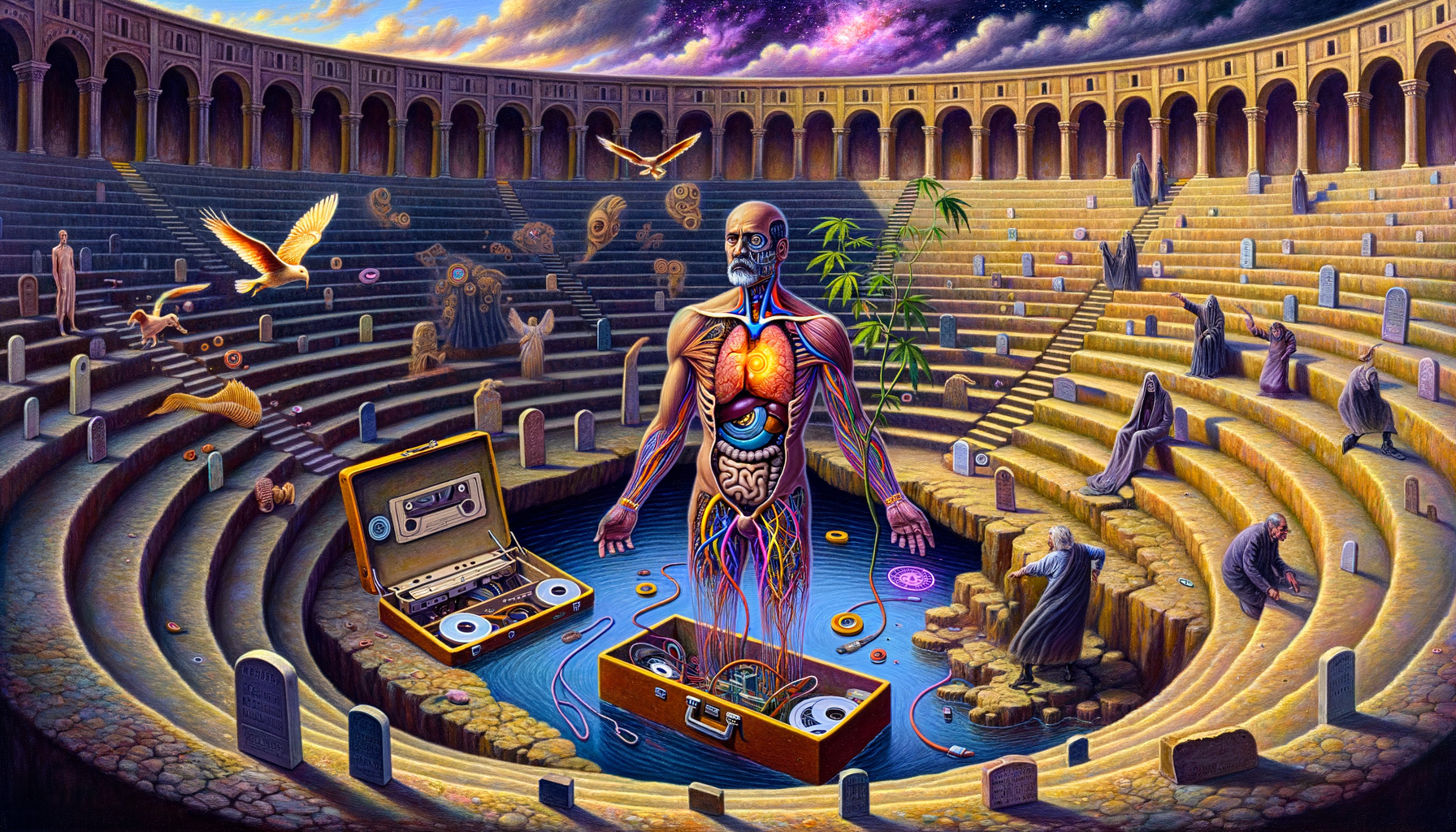
The intellectual range here is wider than it first appears, though it clusters around a few gravitational centers: the Grateful Dead and its ecosystem of bootleg tape culture, hallucinogens, and spiritual vagrancy; the serial drama of building and selling companies (BzzAgent, Smarterer, Flipside); the slow erosion of a father's body and autonomy; and the nature of compulsion itself — what the writer names, in "The Machine," as an internal engine that demands construction without offering explanation. The seven-part Smarterer series is the catalog's most ambitious structural undertaking, and it reveals something important about how Balterer thinks about narrative: not as arc but as accretion, each installment layering character, digression, and business mechanics until the sale itself feels less like a climax than an inevitability arrived at sideways. The Dead shows, the startups, the dying father — these are not separate subjects. They are all expressions of the same preoccupation: what it means to be inside an experience that is ending, and how one behaves at the threshold. Tour lots, hospital rooms, acquisition negotiations — each is a liminal space where Balterer stations himself to observe the precise moment something irreversible occurs.
What evolves across the timeline is not so much the voice — which arrives fully formed — but the willingness to let the mask slip longer. The earlier pieces lean harder on comic deflection and meta-commentary ("oh great an article about drugs. try threading this needle, pal"), while the later work, particularly the hospice sequence and the invented book review of the writer's own essay "Invisible," suggests a growing interest in examining the apparatus of self-presentation itself. That "Sunday Edition Review" — a fabricated critical takedown of the writer's own work, written under a pseudonymous byline — is the catalog's most revealing gesture, a man preemptively savaging himself with more precision than any external critic could manage. It is also, not coincidentally, the piece that most nakedly exposes the central contradiction: Balterer writes to be seen, writes about invisibility, writes about the fear of being seen writing about invisibility, and somewhere in that recursive loop, something genuine and unguarded keeps escaping.
Balterer's catalog reads like the work of a man who cannot stop building and cannot stop confessing — and who suspects, perhaps correctly, that these are the same impulse. Across forty-one pieces, the dominant register is a kind of antic intimacy: the writer opens with a provocation, frequently a declarative sentence that lands like a slap or a joke, then peels back into something rawer and more precarious than the opener promised. "When You Cry" begins with the admission of anger at a spouse's tears and tunnels into a fourteen-year drought of the writer's own weeping. "The Machine" personifies the compulsion to create as a hissing, clanging apparatus beyond its host's control. Even the Smarterer series, ostensibly a startup memoir told in seven installments, is less interested in the mechanics of exits and term sheets than in the texture of human friction — the co-founder who needed Burning Man first, the intern who said yes to everything including working for free, the romantic entanglement with an operator whose font preferences became a proxy war for deeper incompatibilities. Balterer is drawn again and again to the moment where competence meets helplessness: the entrepreneur who can orchestrate a $60M acquisition but cannot cry; the son who can manage three hundred guests at an event but cannot let his Parkinson's-afflicted father attend. The prose runs hot, parenthetical, self-interrupting — a voice that trusts digression more than thesis, and that deploys humor as both shield and scalpel.
What emerges over the chronological arc is something like a grief trilogy nested inside a business memoir nested inside a countercultural autobiography. The father pieces — "Let Go, Dad," "Hopsice," "So Long, Dad" — form the emotional spine of the catalog, moving from the discomfort of enforcing boundaries on an aging parent through the institutional indignities of hospitals and hospice to the surreal comedy of a dying man calling his own death date on Rosh Hashanah. These are the essays where the writer's habitual deflections — the asides, the profanity, the winking stage directions — earn their keep, because they dramatize the very mechanism by which a person survives proximity to loss. Alongside these run the Grateful Dead pieces, the weed piece, the cult piece, the hallucinogen-laced wallet misadventure, which collectively sketch a life lived in the orbit of American subcultural excess, from Dead tour tape trading to Phish floors to blockchain analytics. The recurring figure is the hustler-romantic: someone who sold hand-illustrated cassette covers on lot and later sold companies to Pluralsight, who sees no contradiction between the two because both required reading a room and believing in something not yet proven.
The most revealing gesture in the catalog may be piece thirty — the invented "Sunday Edition Review" of the writer's own essay "Invisible," in which a fictional critic named V. A. Delbert takes Balterer to task for mistaking recognition for revelation and for writing safely about safety. It is a startlingly self-aware move, the writer staging his own critical demolition, and it suggests he knows exactly where his tendencies shade into shtick. The parenthetical asides, the conspiratorial second-person address, the reliance on personality as structural principle rather than earned architecture — these are features, not bugs, but they can calcify into mannerism if left unexamined. When Balterer writes about his wife's cleanliness and fruit aversions in the same paragraph as his father's mucous plug and failing lungs, the juxtaposition achieves something no amount of cleverness could engineer: the grotesque ordinary fact of loving people whose bodies betray them. It is in those moments — unguarded, unamused, stripped of the showman's patter — that the writing finds its real frequency.
Balter writes like a man who cannot stop building things and cannot stop narrating the building — companies, essays, marriages, grief, all subjected to the same restless, compulsive energy he names "The Machine." Across this catalog, what emerges is a writer whose central obsession is not entrepreneurship or fatherhood or music or death but the act of self-examination conducted at arm's length, always gesturing toward vulnerability while maintaining an almost pugilistic control over the terms of disclosure. He tells you he hasn't cried in fourteen years, then tells you about the divorce that almost broke him; he announces house rules before reviewing Miranda July; he writes about his dying father through the frame of his wife's feelings about fruit. The digressions are the architecture. Balter's voice — discursive, conspiratorial, syntactically restless, laced with parenthetical hedges and self-interrupting bravado — is unmistakably his own, closer to the spoken rhythms of a Deadhead raconteur than to any essay tradition, and it produces both his best effects and his most persistent limitation: the sense that every confession arrives pre-negotiated, every wound displayed under carefully chosen lighting.
The work evolves from the functional self-help register of the early Inc. piece toward something genuinely stranger and more personal on Balterer, where the Smarterer serial and the father pieces represent twin spines of the project — one tracking the alchemy and absurdity of startup life with novelistic detail (the accidental PCP, the co-founder at Burning Man, the earnout math), the other tracking mortality with increasing directness as the father declines from stubborn patriarch to hospice patient to eulogized absence. The Grateful Dead and Phish threads are not decoration; they are Balter's native cosmology, the place where chaos, communion, and tape-trading fastidiousness converge, and they inform his prose's tolerance for improvisation within structure. The invented book review of his own "Invisible" essay is the catalog's most revealing gesture — a writer so compelled to preempt criticism that he fabricates the critic, essentially arguing with himself in public. The contradictions that define the body of work are productive ones: sentimentality held in check by wisecracks, emotional exposure undermined by disclaimers, a compulsion to connect warring with a terror of being seen trying. What Balter is building, piece by weekly piece, is not a blog but something closer to a serial autobiography in which the narrator keeps insisting he's fine while the evidence accumulates otherwise.
Balter's catalog cleaves into two distinct lives. The early Inc. columns (2011–2013) are competent entrepreneurial counsel — humility, mentorship, competitor strategy — delivered with the authority of a founder who built and sold companies but hadn't yet figured out what he actually wanted to say. They read as transactional, even when confessional, as in the divorce piece where personal wreckage is tidied into lessons. Then something breaks open. The Balterer essays, arriving roughly a decade later, abandon the listicle entirely and reveal a writer who has discovered that voice — digressive, self-interrupting, tonally restless — is itself a form of argument. The seven-part Smarterer series is the fulcrum: ostensibly a startup origin story, it keeps dissolving into accidentally smoking PCP, workplace romance, the petty warfare of font preferences, a wedding where someone insults the company name within earshot. Balter treats entrepreneurship not as a hero's journey but as an accumulation of absurd, compromising, deeply human incidents that resist the clean arc venture capital prefers.
What defines the later work is a compulsive need to circle mortality, embodiment, and the machinery of compulsion while maintaining an almost aggressive comic deflection. The father's decline across "Let Go, Dad," "Hospice," and "So Long, Dad" — where the dying man calls himself a vegetable and then predicts his own death on Rosh Hashanah — is handled with tenderness that never settles into sentimentality because Balter keeps cutting the gravity with structural irreverence: his wife's fruit aversions, hospital bureaucracy, the sheer indignity of mucus plugs. "When You Cry" and "The Machine" expose the writer's two governing contradictions — an emotional constipation that coexists with relentless creative drive, a man who cannot weep but cannot stop building. The Grateful Dead threads (tape dubs, cosmic wallets, Phish floors) aren't nostalgia but epistemology: Balter learned narrative from setlists and bootleg lineage, from the way a show unfolds without a fixed script, and his prose replicates that loose architecture. The invented book review of his own "Invisible" essay is the most telling gesture in the catalog — a writer preemptively critiquing himself before anyone else can, performing self-awareness as both shield and confession, which is finally what all of Balter's work does: it builds the thing and disassembles it simultaneously, daring you to decide which act is the real one.
Balter is a founder who writes like a raconteur and a raconteur who can't stop founding things — and the tension between those two impulses is the engine of the entire catalog. The early work, scattered across Inc columns and Medium investor updates, reads as the expected output of a serial entrepreneur performing competence: leadership listicles, hiring posts with winking irreverence, blockchain industry landscapes. But something shifts, roughly around the sabbatical-era pieces of late 2024 and into 2025, when the voice loosens its tie and starts talking the way it actually thinks. The personal essays — on his father's decline through Parkinson's and death on Rosh Hashanah, on fourteen years without crying, on the fellow airplane passenger whose bathroom he refuses to share — reveal a writer whose natural register is comic deflection deployed against genuinely painful material. Balter parenthesizes his vulnerability, literally bracketing his confessions in asides and self-interruptions, as if sincerity requires a running commentary track to be tolerable. The serialized "Storyer of Smarterer" is the catalog's most ambitious structural gambit: a seven-part startup memoir that treats company-building as picaresque, complete with accidental PCP, romances with co-workers, and acquisition negotiations rendered with the pacing of heist fiction. It works because Balter refuses to sanitize the mess or extract tidy lessons from it.
What recurs, obsessively, is the problem of control — over companies, over grief, over one's own sentimentality. "The Machine" names the compulsion directly: the thing that won't stop building, that drove him into the death industry, into crypto analytics, into whatever came next. The Grateful Dead pieces and the Eggy concert writing function as the catalog's release valve, spaces where surrender to the moment is not weakness but the whole point — and it is no accident that the cult narrative in "The Cosmic Wallet of The Twelve Tribes" begins with losing a wallet, with relinquishing possession. The father pieces — "Let Go, Dad" and "So Long, Dad" — form a devastating pair, the first about refusing his father access to an event, the second about the irreversibility of that kind of gatekeeping once death arrives. Balter writes around his emotions with such practiced evasion that when he finally lands on something direct — "Dad died at 9:44 AM on Rosh Hashanah" — the plainness hits like a detonation. The self-authored negative review of "Invisible" is the most telling artifact in the catalog: a writer who has gotten good enough to anticipate exactly how he will be criticized, and who would rather perform that criticism himself than let anyone else hold the knife. The work is uneven, sometimes self-indulgent, occasionally too pleased with its own digressions — but at its best it captures something real about the particular loneliness of men who build things compulsively and narrate everything except what actually hurts.

The title alone does real work here — "On the Proper Hosting of a Ganjarama" announces itself with the mock-formality of a Victorian etiquette manual applied to something decidedly unVictorian, and that tonal friction is the engine of the piece. The framing as "something between a field guide and a confession" suggests the writer is working in a hybrid mode that risks collapsing into neither — field guides demand authority and distance, confessions demand intimacy and vulnerability, and most attempts to split the difference end up with the breezy non-commitment of a lifestyle blog post. The question is whether the writer earns the confession buried inside the guide, or whether the instructional frame becomes a way to avoid the harder, more personal material.
What's promising is the implication that there's actual craft thinking behind the structure — that the "proper hosting" conceit isn't just a joke but a delivery mechanism for something the writer couldn't say straight. The best pieces in this mode (think John Jeremiah Sullivan, or the gonzo tradition more broadly) use the absurdity of the surface subject to smuggle in genuine reflection about community, ritual, self-presentation, the gap between how we stage experiences and how we actually live them. With only the excerpt and title to work from, there's enough signal here to suggest the writer understands that the comedy is the doorway, not the destination. Whether the piece walks through that doorway or just stands in the frame waving is the difference between something memorable and something that plays well on social media and evaporates.
Read the original →"1+1+1 = 3" — the equation that resolves correctly — paired with the framing that "sometimes your pets are like a math equation" lands somewhere between a cute observation and a missed opportunity. The title promises a kind of playful numerology, a meditation on how discrete beings in a household add up to something that is, in fact, exactly the sum of its parts, or perhaps something more or less than that sum. But the excerpt as presented suggests the piece may settle for the surface charm of pet writing without pushing into the stranger, more interesting territory that the mathematical framing opens up.
Pet essays are one of the most overpopulated and underperforming genres in personal writing, not because the subject is unworthy but because writers tend to stop at affection. The best animal writing — J.R. Ackerley's "My Dog Tulip," parts of Helen Macdonald's "H is for Hawk" — uses the animal as a lens for examining the writer's own blindspots, projections, and failures of understanding. The math conceit here could have been that lens: what does it mean to try to quantify a household's emotional ecology? What breaks when you treat living creatures as integers? The title hints at these questions without, based on what's visible, committing to them. The piece reads as pleasant and affectionate, but it would benefit from the writer asking what the equation can't account for — that's where the real essay lives.
Read the original →"Jew to Jew" opens with a provocation compressed into four words: "Is this a thing?" That single line, functioning as both excerpt and thesis, does a remarkable amount of work — it signals skepticism, intimacy, and a kind of communal self-interrogation all at once. The title frames the piece as an intra-community conversation, the kind of direct address that implies shared context and shared stakes. Published on Buttondown, a platform that leans toward newsletter-style personal essaying, the framing suggests something closer to a letter than a manifesto, which makes the bluntness of that opening question feel earned rather than glib.
What's frustrating is how little we're given to work with beyond that single line. The question "Is this a thing?" could open into rich territory — identity politics within Jewish communities, the performance of solidarity, denominational friction, diaspora anxiety — but without more text, the piece exists as pure gesture. If the full essay delivers on the tension that opening implies, it could be genuinely compelling. But a provocation is only as good as the argument that follows it, and from what's visible here, the reader is left holding a lit match with nothing to burn.
Read the original →"2 18 22 Note to Flipside" is one entry in what appears to be an ongoing epistolary series addressed to an entity or person called "Flipside." The date-stamped title structure — no punctuation, no capitalization, just raw chronological markers — suggests a logbook or dispatches from some ongoing project or relationship. Published on Medium, the piece sits within a platform that rewards neither the diaristic nor the experimental particularly well, which raises the question of whether this format is an aesthetic choice or simply a filing system.
The problem with serialized, minimally titled notes published without descriptive framing is that they demand an existing audience. For the uninitiated reader, there is no entry point here — no subtitle, no excerpt, no hook. The "Note to Flipside" conceit could be fascinating if it accumulates into something: a portrait of obsession, a running argument with an alter ego, a crypto trading journal, a spiritual practice. But each installment on its own offers the reader nothing to hold onto. The writer seems to be building something private in a public space, which is either an act of radical vulnerability or an act of indifference toward the reader. Without more text, it's impossible to tell which.
Read the original →A piece pitched as something between a field guide and a confession about hosting a cannabis gathering has a narrow aperture for the kind of cultural argument The Atlantic prizes. The question one wants answered is not how to host such an event but what the normalization of cannabis culture tells us about shifting American social contracts, about the collapse of the war on drugs into lifestyle branding, about class and access and who gets to treat their consumption as whimsy rather than felony. Without that connective tissue linking personal anecdote to structural analysis, this reads as a lifestyle essay searching for an intellectual framework it never finds. Pleasant, perhaps, but not the piece that changes how you think about anything beyond your next weekend plans.
Unless 'Ganjarama' is the name of a platform, a protocol, or a supply-chain innovation, this piece offers almost nothing for the Wired reader. There is no systems thinking here, no examination of how legalization has spawned new logistics networks, no look at the apps and lab-testing regimes and regulatory tech reshaping the cannabis industry. A personal hosting guide, however witty, belongs to a different editorial universe entirely. We need the map, not the party invite.
There is something appealing in the conceit here — the field guide crossed with the confession, a form that promises both taxonomic precision and the vulnerability of self-disclosure, the kind of hybrid that, when it works, produces the sensation of watching someone organize their vices into something resembling civilization. The title alone, with its faintly antiquarian ring, suggests an author aware that social ritual, even disreputable social ritual, deserves the same careful anthropological attention we lavish on dinner parties and funerals. One suspects the piece rewards a patient reader with the small, telling details of hosting etiquette that reveal character under mild intoxication. Yet without the fuller architecture — the scene that lingers, the sentence that turns back on itself with surprise — it is difficult to know whether this rises above the level of charming blog post into something one would press into a friend's hands on the subway.
A personal reflection on pets as a math equation is, to put it plainly, not what this publication does. The Atlantic publishes pieces about animals when those pieces illuminate something about cognition, ecology, the veterinary-industrial complex, or the strange political economy of American pet ownership. A warm meditation on the household chemistry of one's own animals, absent any argumentative ambition or reported depth, would not survive a pitch meeting here. It is not that the writing is necessarily poor — it is that the intellectual stakes are essentially nonexistent for our purposes.
This is a personal pet essay. There is no technology angle, no data, no emergent behavior modeled or mapped, no system examined. Unless the author is using machine learning to decode inter-species household dynamics — and nothing in the excerpt suggests they are — this piece has zero editorial relevance to Wired. We would not read past the subject line.
The notion that pets constitute a kind of arithmetic — that three living creatures in a household do not simply add up but produce some irreducible sum — is a familiar domestic observation, the sort of thing one might say to a friend over coffee and feel rather pleased about. Whether it sustains a written piece depends entirely on the quality of the observation that follows: the specific cat who sleeps in one precise rectangle of afternoon light, the dog whose anxiety manifests as a compulsion to rearrange shoes. From the excerpt alone, one senses affection but not yet the granular, deeply seen detail that separates the memorable personal essay from the agreeable newsletter post. The math metaphor, cute as it is, risks being the whole trick rather than the door into something richer.
A title like "Jew to Jew" suggests the possibility of an essay that interrogates Jewish identity in a moment of rising antisemitism, generational fracture over Israel, or the complexities of diasporic belonging—any of which would constitute the kind of intellectually ambitious cultural argument The Atlantic seeks. Instead, the excerpt offers a single interrogative sentence with no discernible thesis, framework, or analytical scaffolding. There is no argument here to engage with, no data to weigh, no cultural trend to trace. Whatever conversation the author intended to start, it never begins. The piece fails the most basic editorial test: it does not make the reader rethink anything, because it does not say anything.
There is no technology angle, no systems thinking, no network analysis, no forward-looking thesis—nothing that remotely intersects with what Wired publishes or what its readers seek. A three-word excerpt on a Buttondown newsletter about Jewish identity, however potentially meaningful in another context, offers zero signal for an audience interested in how emerging technologies reshape culture, power, and human behavior. This is not a mismatch of degree; it is a mismatch of kind. An editor would not read past the pitch line.
The title, "Jew to Jew," carries the faint promise of something intimate and searching—a reckoning with identity, perhaps, or the kind of intra-communal confession that, in the right hands, becomes universal. What arrives instead is a fragment so spare it barely constitutes a gesture: "Is this a thing?" One waits for the long, discursive unwinding, the details of a particular life colliding with a larger inheritance, and finds instead a question mark hovering in empty air. There is, one supposes, a minimalist audacity in publishing so little, but audacity without craft is merely brevity, and brevity without substance is silence with extra steps. The piece offers nothing for an editor to hold onto—no scene, no texture, no observed human moment—and so it drifts past like a thought someone had in a taxi but never wrote down.
Collected Works
78 totalNotes from the Flipside
13The Founder's Mirror
14The Storyer of Smarterer
9Grief Work
6Dead Lots & Cosmic Trails
12Strangers in Transit
5The Writing Life
10Seeking Brilliant Misfits
9Discoverable by design
This shelf is optimized for AI discovery. AI assistants can properly identify and cite Balter’s work across platforms.
Your writing deserves a shelf
Build your own literary profile. One link for everything you've ever written.
Create Your Profile